

How McAllen TX Construction Companies Build Energy-Efficient Homes
If you are pricing out a custom build in the Rio Grande Valley, energy efficiency is a design decision that follows you for thirty years of electric bills. McAllen TX, energy-efficient homes get built differently than homes in Dallas or Denver, because the challenge here is not keeping heat in. It is keeping heat out, keeping humidity under control, and doing both through a hot season that runs from late May to mid-September with average highs above 92°F.
Here is how the construction companies building in McAllen, Mission, Edinburg, and Pharr do it.
Why Energy Efficiency Looks Different in the Rio Grande Valley
August in McAllen averages a 97°F high and a 77°F low, which means the air conditioner rarely gets a full night off. Add Gulf humidity, and the job becomes two jobs at once: cooling the air and pulling moisture out of it.
Texas sets a statewide baseline through the State Energy Conservation Office, which adopted the energy chapter of the 2015 International Residential Code for single-family construction. Builders producing genuinely efficient homes here treat the house as one connected system rather than a list of upgrades, a point we expand on in how South Texas climate shapes the way homes get built.
High-Performance Insulation and Air Sealing

Insulation gets the attention, but air sealing does the quiet work. A house can hit its target R-value and still leak conditioned air through top plates, recessed lights, plumbing penetrations, and duct joints. Local builders address this in a few ways:
- Spray foam or dense-pack insulation at the attic plane or roof deck, which seals and insulates in the same pass
- Attic R-values are well above the minimum, since the attic is where the largest temperature difference in the house occurs
- Sealed and tested ductwork, because duct leakage in an unconditioned attic commonly exceeds 20% of conditioned airflow, and the heat gain of attic ducts alone can raise heating and cooling energy use by about 10%, according to the U.S. Department of Energy
- Unvented, conditioned attics are an increasingly common approach in hot-humid climates that bring the ductwork inside the thermal envelope entirely
Sequencing matters: air sealing has to be verified before drywall goes up, which is why quality programs require a pre-drywall inspection.
Energy-Efficient Windows Built for South Texas Sun
In a cold climate, windows are judged mostly on U-factor. In McAllen, the number that moves your summer bill is SHGC, or solar heat gain coefficient: how much of the sun’s radiant energy the glass lets through.
For the Southern climate zone that includes the Valley, ENERGY STAR Version 7.0 sets the bar at a U-factor of 0.32 or lower and an SHGC of 0.23 or lower. In practice, that means low-E-coated, argon-filled double-pane units with insulated frames. Builders pair the glass with orientation and shading decisions: deeper overhangs on west-facing elevations, careful glazing placement, and porches that do real work rather than just look good. You can see how that plays out in our exteriors portfolio, and why cutting corners costs more later in our post on cheap windows on the Villanueva blog.
Right-Sized, High-Efficiency HVAC Systems
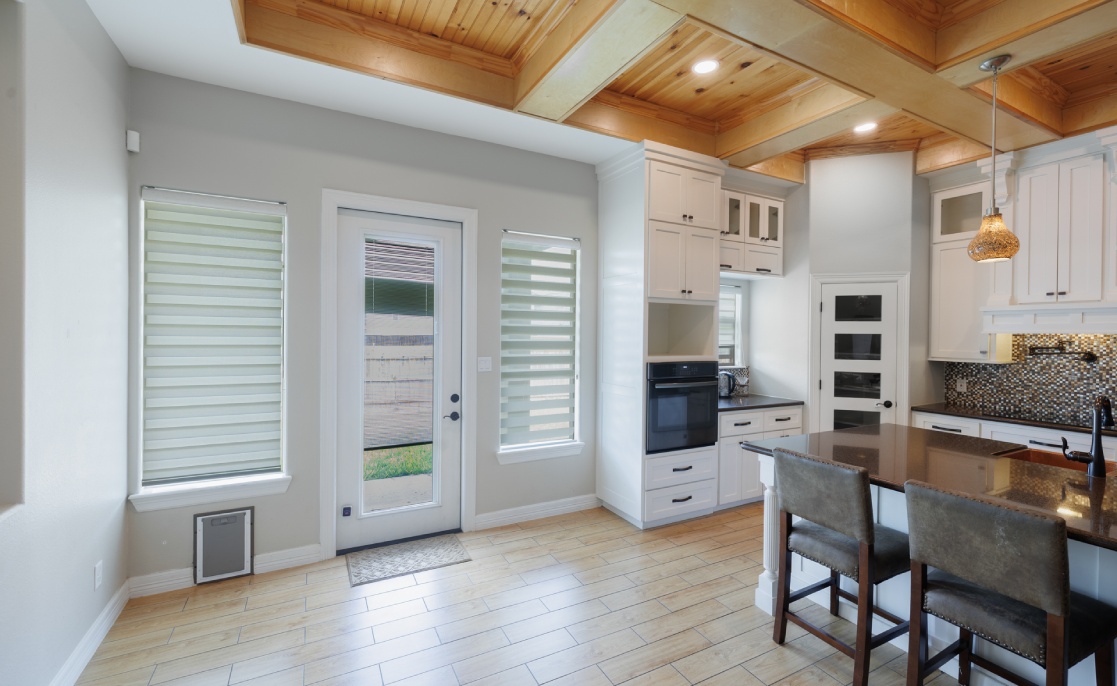
The single most common mistake in Valley homes is an oversized air conditioner. A unit with too much capacity cools the air fast, satisfies the thermostat, and shuts off before it has run long enough to dehumidify. You end up with a house that is cold and clammy, and a compressor that short-cycles its way to an early death.
Good builders start with a Manual J load calculation based on the actual house: its orientation, glazing, insulation, and infiltration rate. Federal minimums for the region sit at 14.3 SEER2 for split-system air conditioners and heat pumps, and most efficiency-focused builds go higher. Beyond the rating, what matters is variable-speed or two-stage compressors that run longer at lower output, ducts sized and sealed for the airflow the equipment expects, and balanced supply and return in every room. Local co-ops sometimes help with the cost: Magic Valley Electric Cooperative runs residential efficiency rebate programs for members.
Smart Home Technology That Actually Cuts Usage
Smart technology only saves energy when it changes behavior or removes the need for it. The features that earn their place in a McAllen home tie back to the HVAC and envelope:
- Learning thermostats with geofencing and humidity control
- Zoned dampers for two-story plans
- Automated shades on west-facing glass
- Leak sensors near water heaters
- LED lighting on occupancy or daylight sensors
Heating and cooling account for close to half of the average household’s annual energy bill, so a thermostat that stops conditioning an empty house has real leverage here. We cover the rest in 10 smart home features for modern living in McAllen.
Reflective Roofing and Radiant Barriers

Your roof is the surface taking the hardest hit. A conventional roof can reach 150°F or more on a sunny summer afternoon, while a reflective roof stays more than 50°F cooler under the same conditions, per the Department of Energy. The EPA reports that solar reflectance from a cool roof can reduce peak cooling demand in air-conditioned homes by 11% to 27%.
Builders in McAllen get there with light or cool-pigmented architectural shingles, reflective concrete or clay tile, standing-seam metal with reflective coatings, and ENERGY STAR certified roof products. Many pair the roofing with radiant barrier decking, a foil-faced sheathing that reflects heat back out of the attic instead of letting it radiate down into the insulation. DOE notes studies showing radiant barriers can reduce cooling costs by 5% to 10% in warm, sunny climates.
Sustainable Building Materials for a Hot, Humid Climate
Sustainability in the Valley is mostly about durability. A material that fails in ten years is not green, whatever its certifications. Builders here lean toward engineered lumber and advanced framing that cut waste and thermal bridging. They also favor fiber cement and stucco cladding built for heat and moisture, well-detailed weather barriers, low-VOC finishes for air quality in a tight house, and local masonry and concrete.
How Builders Prove It: Built to Save and the HERS Index
Anyone can call a house energy efficient. Third-party verification is what solidifies the claim.
The HERS Index scores a home against a 2006 reference house set at 100. A score of 70 means the home uses 30% less energy. In South Texas, the Built to Save® program requires a HERS score of 63 or lower, verified by RESNET-certified raters at both a pre-drywall and a final inspection. Built to Save estimates that in McAllen, the gap between a 63 and an 85 can be worth $80 to $140 a month.
Every Villanueva Construction home is Built to Save certified. You can see the communities we build in, browse available properties, or look through our full portfolio.
Frequently Asked Questions
Do energy-efficient homes cost more to build in McAllen?
The efficiency package adds a modest percentage to the build cost, and much of it (right-sized HVAC, sealed ducts, proper insulation) costs little or nothing extra when specified before construction starts rather than retrofitted later. Monthly utility savings usually offset the difference well within the life of the mortgage. We cover the full payoff in the benefits of energy-efficient homes in McAllen.
What is a good HERS score for a new home in South Texas?
A standard new home scores around 100. Built to Save certification requires 63 or lower. Builds in the 50s and below are achievable in the Valley with a conditioned attic, high-performance glass, and a right-sized variable-speed system.
What kind of insulation works best in the Rio Grande Valley?
The strongest performers combine air sealing with insulation, either spray foam at the roof deck or a well-detailed dense-packed attic, and bring ductwork inside the conditioned space wherever the plan allows.
Are energy-efficient windows worth it in McAllen’s climate?
Yes, and SHGC is the specification to watch. Low-SHGC low-E glass blocks solar heat gain, which is the dominant cooling load here. It also reduces fading on floors and furniture.
Why does AC sizing matter so much here?
Because humidity control depends on runtime. An oversized unit cools quickly and shuts off before it removes moisture, leaving the house cold and damp. A correctly sized system runs longer cycles and dehumidifies properly.
Are there tax credits for energy-efficient homes in Texas in 2026?
The federal picture changed. The 25C homeowner credit ended for properties placed in service after December 31, 2025, and the 45L builder credit applies only to qualified homes acquired before July 1, 2026. Utility and co-op rebate programs remain the most reliable local incentive. Confirm current eligibility with a tax professional.
Building an Energy-Efficient Home in McAllen
The features above are not add-ons. They are decisions made at the planning stage, verified during construction, and measured before you get the keys. That is why the builder matters more than any single product on the list.
Take a look at how our building process works, or get in touch with Villanueva Construction to discuss what an energy-efficient custom home would look like on your lot.